Nervelin Official Website › Blog › What A 1,000 mg Blend Can Hold
What A 1,000 mg Proprietary Blend Can Physically Hold
Nine ingredients share one number on the back of this carton. The number is 1,000 mg. Four of those nine, at the lower amount their own published trials used, want 2,740 mg between them. That subtraction is available to anybody holding the bottle, and it is the most useful thing on the label.
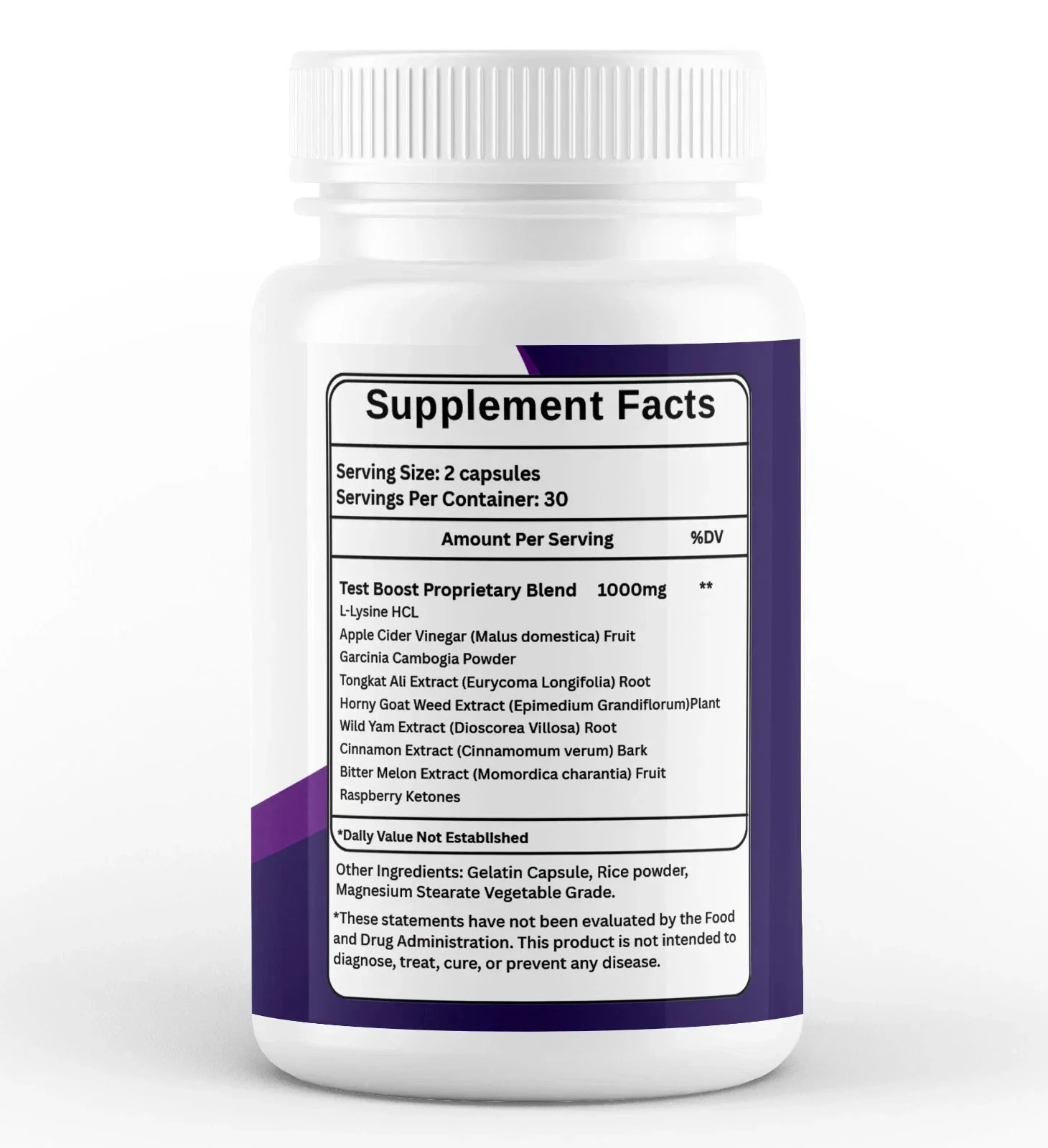
- The panel prints Test Boost Proprietary Blend at 1,000 mg per two-capsule serving.
- Underneath it are 9 names with nothing beside any of them.
- Federal rules put a blend's ingredients in descending order of weight, so the order is the only ranking a buyer is given.
- Divide 1,000 by nine and the flat answer is about 111 mg a row, which is a ceiling rather than a fact: descending order guarantees the split is uneven.
- Four of the nine, at the lower amount their own trials used, want 2,740 mg between them.
The line that does all the work
Turn the carton over and the panel has a shape anybody who has read a supplement label will recognise. Serving size, two capsules. Servings per container, thirty. Then one line in bold: Test Boost Proprietary Blend, 1,000 mg. Then nine names in a column, in ordinary weight, with empty space where a number would go.
That single line is a lawful declaration and it is a complete one, in the sense that the maker has told you everything the rule requires. It is also the point at which a reader's ability to check anything stops. A weight against a name can be compared with a published trial. A weight against nine names cannot be compared with anything.
The %DV column beside it carries one asterisk pair and the footnote reads “Daily Value Not Established”. That footnote is often read as a warning and it is not one. It means the Food and Drug Administration has set no reference intake for these botanicals, which is true of almost every plant extract sold in a capsule, and it says nothing about how much of each is in the bottle.
What descending order concedes, and what it withholds
There is one piece of real information inside a blend line and it is easy to miss. Ingredients inside a proprietary blend must be listed in descending order of predominance by weight. The maker cannot put the flattering name at the top for marketing reasons; the order is a claim about quantity.
So the panel is telling you that L-Lysine HCL is the heaviest of the nine and raspberry ketones the lightest. Between those two ends there are seven rows and no gaps.
| What descending order tells you | What it does not |
|---|---|
| L-Lysine HCL is the heaviest of the nine | By how much |
| Raspberry ketones is the lightest of the nine | Whether that is 90 mg or 2 mg |
| The order cannot be rearranged at will; it is a labelling rule | Whether the top row is half the blend or a ninth of it |
| Anything below the first row holds less than the first row | Whether the bottom four rows together reach 50 mg |
One ranking, no gaps. That is the whole of what a blend line concedes.
The second column is where the whole argument lives. A ranking with no intervals is compatible with almost any distribution. It is compatible with 200 mg at the top and 60 mg at the bottom, and it is equally compatible with 850 mg at the top and 5 mg spread across the last four. Nothing on the carton rules out either shape.
This is not a defect in the printing. It is the design of the disclosure, and it is the reason a reader has to do arithmetic rather than reading a number off a page.
The even split is a ceiling, not an estimate
The temptation is to divide 1,000 by 9, get 111 mg, and treat that as the amount of each. It is worth resisting for a specific reason: descending order guarantees the split is uneven, so 111 mg is a figure no row is likely to hold exactly.
What the even split is genuinely good for is a ceiling. No single row can hold more than the entire blend, and every row after the first has to fit inside whatever the first one leaves. If the top row took 400 mg, the remaining eight would be sharing 600 mg, and the bottom four would be into double figures at best.
- A ceiling is a statement about the maximum, and the maximum here is 1,000 mg for any one ingredient.
- A floor does not exist. Nothing stops an ingredient from being present at a few milligrams.
- The more names a blend carries, the lower the average has to be, which is why a long ingredient list is not the selling point it looks like.
- Two blends of the same weight with different name counts are not comparable products, even where the names overlap.
- None of this requires anybody to assume bad faith. It is what a fixed weight divided several ways means.
Four rows and the arithmetic they set up
Four of the nine names on this panel have human trials with a published daily amount. Setting those amounts beside a 1,000 mg total is the exercise the carton invites, whether or not it meant to.
| Ingredient on this panel | Amount its own trials used | Share of 1,000 mg that needs |
|---|---|---|
| Garcinia cambogia, as hydroxycitric acid | 1,500 mg a day | 150% of the whole blend |
| Horny goat weed, standardised extract | 740 mg a day | 74% of the whole blend |
| Bitter melon, lower arm | 300 mg a day | 30% of the whole blend |
| Tongkat Ali, water-soluble extract | 200 mg a day | 20% of the whole blend |
| Those four together | 2,740 mg a day | 274% of the whole blend |
Four of nine ingredients, each at the lower figure its own published trial used. Five more names are also sharing the same 1,000 mg.
The JAMA Garcinia trial ran 1,500 mg a day of hydroxycitric acid against placebo and reported no effect beyond it. That is a negative result at an amount larger than this whole blend, which makes the row interesting twice over.
The Epimedium trial used 740 mg a day of a standardised prenylflavonoid extract for six weeks. The bitter melon trial ran 300 mg and 600 mg a day for twelve weeks. The Tongkat Ali work settled on 200 mg a day of a standardised water-soluble extract.
Add the four lower figures and the total is 2,740 mg. The blend is 1,000 mg and five further ingredients are inside it. The arithmetic does not say any one row is too small; it says all four cannot be at their trial amounts at once, and nothing on the carton reveals which of them took the cut.
See the whole Nervelin panel before you decide anything
The panel is reproduced at reading size, every row is set beside the amount its own trials used, and the arithmetic above is printed rather than tucked into a footnote.
Price shown at the seller’s checkout · money-back guarantee on the listing window
Order Nervelin On The Official WebsiteTwo capsules a day · 60 per bottle · lot NER-26/GO-5362
None of this is against the rules
It is worth being exact about what is and is not happening here, because label arithmetic attracts a tone this subject does not deserve.
A proprietary blend line is lawful. Declaring a total rather than a breakdown is permitted, descending order is required and this panel complies with both. The footnote is printed correctly. The other-ingredients line is present and readable. Six of the nine rows name a plant part or a chemical form, which is more than a good deal of this category bothers with.
What follows from the blend line is not a violation. It is a limit on what a reader can verify, and a limit is worth stating plainly rather than dramatising.
The three things a blend line still guarantees
- That the nine ingredients together weigh 1,000 mg per two-capsule serving, as declared at manufacture.
- That they appear in descending order of weight, which is a real constraint on the maker.
- That the named plant part is what it says, on the rows that name one.
Why a maker uses a blend line at all
Two reasons are usually given and both of them are true some of the time.
The first is commercial protection. A fully declared panel tells a competitor exactly what to copy, down to the ratios, and a blend line makes that copying guesswork. For a formula somebody spent money developing, that is a real interest.
The second is less flattering and just as real. A blend line lets a formula carry names that read well at amounts that cost little, and nobody outside the plant can tell which names those are. A framework for ingredient-interpretation gaps describes the general shape of the problem: what a label says, what a buyer understands it to say, and what is in the capsule are three separate things.
A reader cannot tell from the outside which reason applies to any particular bottle, and guessing is not analysis. What a reader can do is treat every row as a name without a number, which is what it is.
How to read any blend line in ninety seconds
- Find the bold line. That is the total, and it is the only number on that part of the panel.
- Count the names underneath it. More names means a lower average, always.
- Divide the total by the count and treat the answer as a ceiling on the middle of the list rather than as a figure for anything.
- Look up the published dose for the two or three names you recognise. If any of them is larger than the whole blend, you have learned something.
- Check whether the plant part is named. A part with a literature and a part without one are different ingredients wearing the same English word.
- Read the other-ingredients line, which is where the capsule shell lives and where a dietary problem usually hides.
That sequence works on any panel in any aisle and it takes less time than reading the front of the carton. The federal guidance on using supplements wisely covers the same ground from a different angle and is worth the five minutes.
What this post is not saying
It is not saying this blend is empty, because nobody outside the plant knows what is in it and this desk is not inside the plant. It is not saying the maker has done anything improper, because the panel is printed the way the rule allows.
It is saying that the one number on the carton cannot answer the question a reader actually has, and that the gap between 1,000 mg and 2,740 mg is the honest starting point for anybody deciding whether to buy. A bottle that printed nine amounts would settle it in an afternoon, and a label reprint is all that would take.
Until then the arithmetic stands where the carton leaves it: one weight, nine ways, descending order, and no intervals.
A blend total is a ceiling on every ingredient under it and a figure for none of them.
References
- Tambi MI, Imran MK, Henkel RR. Standardised water-soluble extract of Eurycoma longifolia, Tongkat ali, as testosterone booster for managing men with late-onset hypogonadism? Andrologia. 2012;44 Suppl 1:226-30. PMID 21671978. Dose used: 200 mg/day. https://pubmed.ncbi.nlm.nih.gov/21671978/
- Yong EL, Cheong WF, Huang Z, et al. Randomized, double-blind, placebo-controlled trial to examine the safety, pharmacokinetics and effects of Epimedium prenylflavonoids, on bone specific alkaline phosphatase and the osteoclast adaptor protein TRAF6 in post-menopausal women. Phytomedicine. 2021;91:153680. PMID 34352588. Dose used: 740 mg/day of extract for 6 weeks. https://pubmed.ncbi.nlm.nih.gov/34352588/
- Heymsfield SB, Allison DB, Vasselli JR, et al. Garcinia cambogia (hydroxycitric acid) as a potential antiobesity agent: a randomized controlled trial. JAMA. 1998;280(18):1596-600. PMID 9820262. Dose used: 1,500 mg hydroxycitric acid per day. No effect beyond placebo. https://pubmed.ncbi.nlm.nih.gov/9820262/
- Guarneiri LL, Wilcox ML, Kuan CM, et al. Investigation of the Influence of a Bitter Melon Product on Indicators of Cardiometabolic Health in Adults with Prediabetes. J Am Nutr Assoc. 2025;44(4):306-314. PMID 39536276. Doses used: 300 mg/day and 600 mg/day for 12 weeks. https://pubmed.ncbi.nlm.nih.gov/39536276/
- Alsawadi A. The Perception Filler: A Proposed Conceptual Framework for Ingredient-Interpretation Gaps in Food Supplements. J Nutr. 2026;156(10):101803. PMID 42660500. https://pubmed.ncbi.nlm.nih.gov/42660500/
- National Center for Complementary and Integrative Health. Using Dietary Supplements Wisely. Confirmed live 19 September 2026. https://www.nccih.nih.gov/health/using-dietary-supplements-wisely