Nervelin Official Website › Choosing A Supplement
Choosing A SupplementChoosing A Nerve Supplement: Seven Checks
Seven questions answer most of what a nerve label can be asked: the plant part, the amount per ingredient, the blend line, whether anything on it has a trial for the symptom, what the seals assert, when the price appears and how you get out. Five minutes, any bottle, no product knowledge needed.
A scorecard you can carry to any label, then applied here, failures and all.
The seven checks, in the order they are worth running
Seven questions to ask of any label, whether or not you buy anything from this website.
1. Does the panel name the plant part?
Root, leaf, bark, fruit, aerial parts. The same plant supplies different raw materials with different chemistry and different literatures, and a label that does not say which one is asking you to assume. Six rows on a nine-row panel naming a part is better than most of this aisle manages.
2. Is there an amount against each ingredient?
A number beside a name is what makes a row checkable. Without one, no comparison with any published trial is possible, and the label has told you the recipe without telling you the quantities.
3. Is there a proprietary blend line?
A blend line declares one weight for several ingredients. It is lawful, it is common, and it converts every row underneath it into a name with no number. Treat a blend total as a ceiling on each ingredient, never as a figure for any of them.
4. Does anything on the panel have a trial for the symptom?
Not a trial for something else, and not an animal study. For nerve symptoms the list is short: alpha-lipoic acid, benfotiamine, acetyl-L-carnitine. A label with none of the three has a story rather than an evidence base.
5. What do the seals actually assert?
Facility registration is a filing. Good Manufacturing Practice describes how a plant runs. A money-back roundel is a refund policy. None of the three is a test of the powder, and a wall of them can look like one.
6. Can you see the price before you commit?
A price shown late is a price that expects momentum. It should be visible before a card is out, and a page that shows a struck comparison figure should say who ever paid it.
7. How do you get out?
A named window with a day count, a return address, who pays the postage, and a telephone number answered by somebody who can see the order. A guarantee with no day count on it is a guarantee whose window lives somewhere else.
Seven checks, five minutes, and any bottle in this aisle can be put through them. The order matters: the first four are about whether the product can work, and the last three are about whether buying it is a reasonable risk.
Why those seven and not some other seven
Seven checks, each one traced to the failure it exists to catch.
Because each one corresponds to a documented failure mode rather than to a preference.
| Check | The failure it catches | The evidence it rests on |
|---|---|---|
| Plant part | Buying the part of the plant that was never studied | Pharmacopoeias list plant parts as separate drugs with separate monographs |
| Amount per ingredient | A dusting too small to have any relationship to a trial | Every dose figure in the trial literature, which exists for a reason |
| Proprietary blend | Nine names sharing one number that could divide any way at all | Federal labelling rules permit the blend line and require only descending order |
| Trial for the symptom | An ingredient with a glowing literature about something else | the alpha-lipoic acid review, BENDIP, the carnitine trial |
| Seals | Reading a process mark as a content test | DNA barcoding of saw palmetto products and the ginkgo study |
| Price visible early | A total that appears only once momentum has been built | Ordinary commercial practice, and the reason this website prints none |
| The exit | A guarantee that turns out to belong to somebody else | A satisfaction seal with no day count is a real thing that exists |
Seven checks, seven failure modes. The fifth row is the one most buyers are surprised by.
The barcoding studies in the fifth row are worth reading in full. The saw palmetto work, the ginkgo work and the devil’s claw work each took shelf products and asked whether the plant on the label was the plant in the capsule. The answers were not uniform, and no seal on any of those cartons would have predicted which was which.
A framework for ingredient-interpretation gaps describes the general problem these checks are built around: what a label says, what a buyer understands it to say, and what is actually in the product are three different things.
A worked example: the same seven checks on three imaginary labels
Three sketches, three scores, and why the longest ingredient list scores worst.
The scorecard earns its keep when two bottles look identical on the front and separate immediately on the back. Three sketches, none of them a real product, to show what each result looks like in practice.
Label A: the fully declared panel
Six actives, an amount against every one, the plant part in brackets on four of them, and one ingredient sitting at the dose its own trials used.
Six of seven, and the seventh only because its guarantee window is printed on the website rather than on the carton. A reader can check this label without trusting anybody.
Label B: the blend with a long list
Eighteen names under a single 1,200 mg blend line, no plant parts, and a front carton naming a symptom the panel has no trial for.
Two of seven. The long list is the problem rather than the selling point: eighteen ways of dividing 1,200 mg means an average of 66 mg a name, and the descending order guarantees most of them hold less.
Label C: the single ingredient at its trial dose
One active, 600 mg, the compound’s own review cited on the carton, a plain price and a thirty-day window printed beside it.
Seven of seven, and the least impressive-looking bottle of the three. A panel with one row on it is a panel where every row can be checked.
Label B is the shape most of this aisle takes, and the instinct it plays on is that more names must mean more value. The arithmetic runs the other way: a fixed weight divided more ways is less of each, and a blend line hides which ones took the cut.
Label C is the one a careful buyer ends up with more often than he expects. It is also the shape the three trialled nerve compounds naturally take, because 600 mg, 600 mg and 2,000 mg do not leave room for a supporting cast.
Nervelin scored against all seven
Seven rows, applied to the bottle this website sells, failures included.
The scorecard is worth nothing if it is never applied to the product on the website that publishes it, so here it is, including the rows this bottle loses.
| Check | Result | Why |
|---|---|---|
| 1. Plant part named | Pass | Six of the nine rows name a part or a form: root for Tongkat Ali and wild yam, bark for cinnamon, fruit for bitter melon and Garcinia, plant for Epimedium |
| 2. Amount per ingredient | Fail | No row carries one. The panel prints 1,000 mg once, for the blend, and lists 9 names underneath it |
| 3. Proprietary blend | Fail | Test Boost Proprietary Blend is exactly that. Descending order is the only ranking a buyer gets |
| 4. Trial for the symptom | Fail | None of the nine has a human peripheral-nerve trial. The three compounds that do are not on this panel |
| 5. Seals read honestly | Pass | Four seals, three of them process statements and one a refund policy, each one read out loud on the quality page |
| 6. Price visible early | Partial | This website prints no figure, because the seller’s listing could not be read. The checkout shows the total before anything is charged |
| 7. The exit | Partial | A named return address, a telephone desk that can start a refund, and a satisfaction roundel with no day count, so the window is the listing’s |
Two clear passes, three clear failures, two partials. Published here rather than on a page nobody links to.
The three failures are one fact wearing three hats. A proprietary blend removes the amounts, the missing amounts remove the comparison, and without a comparison the absent nerve evidence cannot even be argued about. Fixing the first would fix all three, and fixing it costs a label reprint rather than a reformulation.
The two passes are real and worth having. Six rows naming a plant part is better than much of this aisle, and it is the reason the ingredients page can compare row by row at all. A panel that said only “herbal blend” would leave nothing to check.
The two partials share a cause as well. No price and no day count both come from the same blocked listing, and both are stated as gaps rather than filled with a guess.
Four changes that would move three of those rows
Worth setting out, because a criticism with no remedy attached is just a complaint.
Print an amount against each of the nine
The single change that would move rows two and three at once. It is a label decision rather than a formula decision, and every row underneath would become checkable against its own literature the same afternoon.
Publish an assay for a lot
Lot NER-26/GO-5362 indexes a run. A per-ingredient breakdown for that run, signed by whoever measured it, would answer the question the panel raises and would cost one laboratory fee.
Put a day count on the money-back seal
A roundel printed with a number moves row seven from partial to pass and removes the need for anybody to go and read a marketplace listing to find out where they stand.
Say what the blend is for on the back as well as the front
The front prints nerve support; the back prints a name that reads like a testosterone stack. One of the two is the formula and a buyer should not have to work out which.
None of those four is expensive and none of them requires a new formula. They are the difference between a label a reader can check and a label a reader has to trust, and that difference is the whole of what this scorecard measures.
Sources for these seven checks
The nerve trials the fourth check rests on, and the authentication studies behind the fifth.
- Ziegler D. Thioctic acid for patients with symptomatic diabetic polyneuropathy: a critical review. Treat Endocrinol. 2004;3(3):173-89. PMID 16026113. Dose used: 600 mg/day. https://pubmed.ncbi.nlm.nih.gov/16026113/
- Stracke H, Gaus W, Achenbach U, et al. Benfotiamine in diabetic polyneuropathy (BENDIP): results of a randomised, double blind, placebo-controlled clinical study. Exp Clin Endocrinol Diabetes. 2008;116(10):600-5. PMID 18473286. Doses used: 300 mg/day and 600 mg/day. https://pubmed.ncbi.nlm.nih.gov/18473286/
- De Grandis D, Minardi C. Acetyl-L-carnitine (levacecarnine) in the treatment of diabetic neuropathy. A long-term, randomised, double-blind, placebo-controlled study. Drugs R D. 2002;3(4):223-31. PMID 12455197. Dose used: 1,000 mg/day intramuscular for 10 days, then 2,000 mg/day orally for the remaining 355 days. https://pubmed.ncbi.nlm.nih.gov/12455197/
- Little DP, Jeanson ML. DNA barcode authentication of saw palmetto herbal dietary supplements. Sci Rep. 2013;3:3518. PMID 24343362. https://pubmed.ncbi.nlm.nih.gov/24343362/
- Little DP. Authentication of Ginkgo biloba herbal dietary supplements using DNA barcoding. Genome. 2014;57(9):513-6. PMID 25495290. https://pubmed.ncbi.nlm.nih.gov/25495290/
- Diaz-Silveira GL, Deutsch J, Little DP. DNA Barcode Authentication of Devil's Claw Herbal Dietary Supplements. Plants (Basel). 2021;10. PMID 34685813. https://pubmed.ncbi.nlm.nih.gov/34685813/
- Alsawadi A. The Perception Filler: A Proposed Conceptual Framework for Ingredient-Interpretation Gaps in Food Supplements. J Nutr. 2026;156(10):101803. PMID 42660500. https://pubmed.ncbi.nlm.nih.gov/42660500/
- Al-Omairi M, Alamir SG, Salman BI, et al. Investigating Trace and Macro-element Composition of Herbal and Nutraceutical Dietary Supplements Marketed in Oman: Insights into Safety and Labeling. Biol Trace Elem Res. 2025;203(5):2911-2923. PMID 39143445. https://pubmed.ncbi.nlm.nih.gov/39143445/
- National Center for Complementary and Integrative Health. Dietary and Herbal Supplements. Confirmed live 19 September 2026. https://www.nccih.nih.gov/health/dietary-and-herbal-supplements
- National Center for Complementary and Integrative Health. Using Dietary Supplements Wisely. Confirmed live 19 September 2026. https://www.nccih.nih.gov/health/using-dietary-supplements-wisely
- Tambi MI, Imran MK, Henkel RR. Standardised water-soluble extract of Eurycoma longifolia, Tongkat ali, as testosterone booster for managing men with late-onset hypogonadism? Andrologia. 2012;44 Suppl 1:226-30. PMID 21671978. Dose used: 200 mg/day. https://pubmed.ncbi.nlm.nih.gov/21671978/
- Yong EL, Cheong WF, Huang Z, et al. Randomized, double-blind, placebo-controlled trial to examine the safety, pharmacokinetics and effects of Epimedium prenylflavonoids, on bone specific alkaline phosphatase and the osteoclast adaptor protein TRAF6 in post-menopausal women. Phytomedicine. 2021;91:153680. PMID 34352588. Dose used: 740 mg/day of extract for 6 weeks. https://pubmed.ncbi.nlm.nih.gov/34352588/
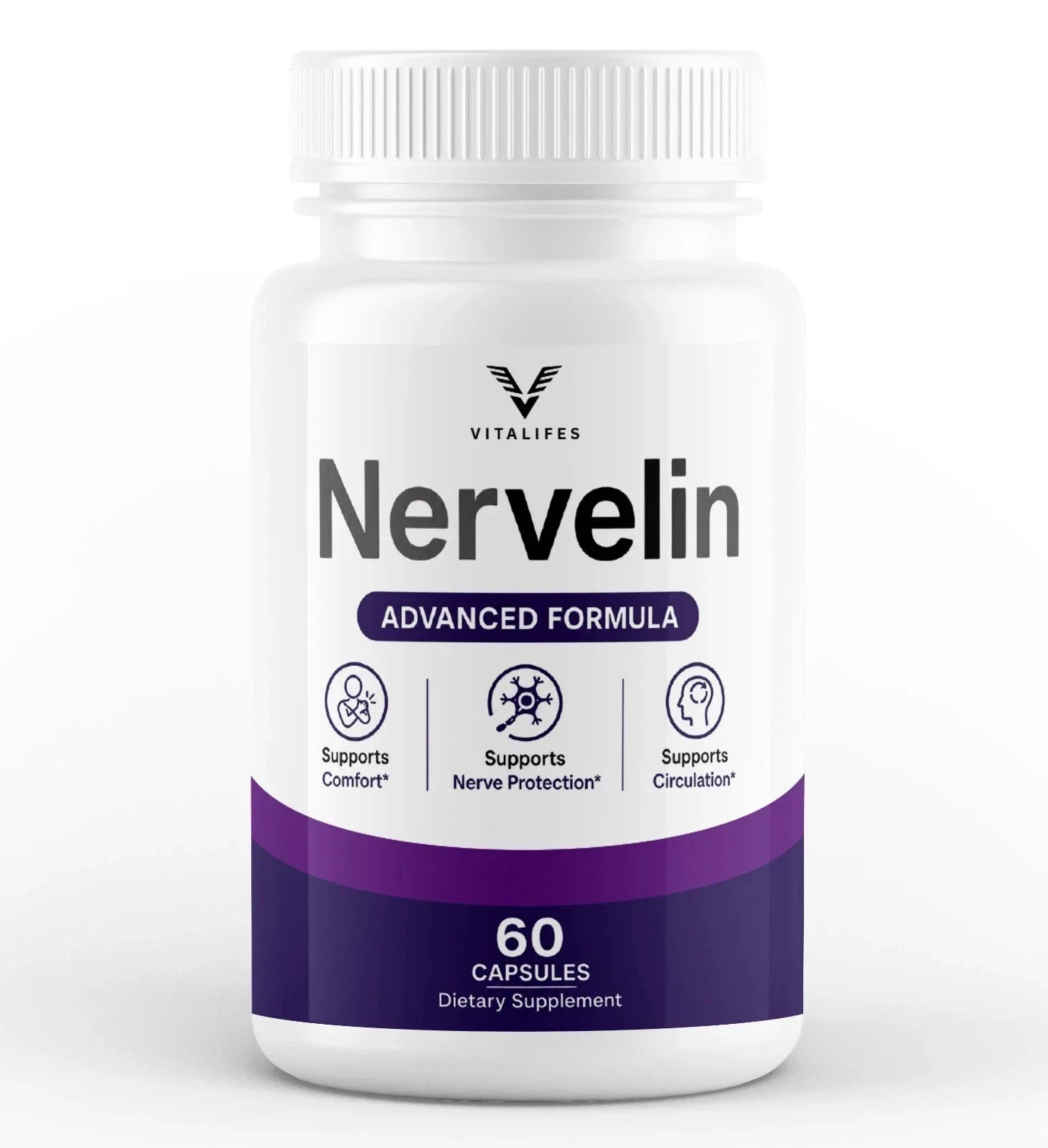
Run the seven checks on Nervelin yourself
The panel is reproduced at reading size, the trial amounts sit beside each ingredient, and the scorecard above shows where this bottle loses.
Price shown at the seller’s checkout · money-back guarantee on the listing window
Order Nervelin On The Official WebsiteTwo capsules a day · 60 per bottle · lot NER-26/GO-5362