Nervelin Official Website › Ingredients
IngredientsNervelin Ingredients
The Nervelin panel names nine ingredients and prints one weight for all of them together.
L-lysine, apple cider vinegar, Garcinia cambogia, Tongkat Ali, horny goat weed, wild yam, cinnamon, bitter melon and raspberry ketones share 1,000 mg per two-capsule serving. Six rows name a plant part. None names a percentage.
Every name on the panel, what it is made of, and where its human evidence actually sits.
What is printed on the Nervelin label?
Seven lines govern everything below, and only one of them is a number.
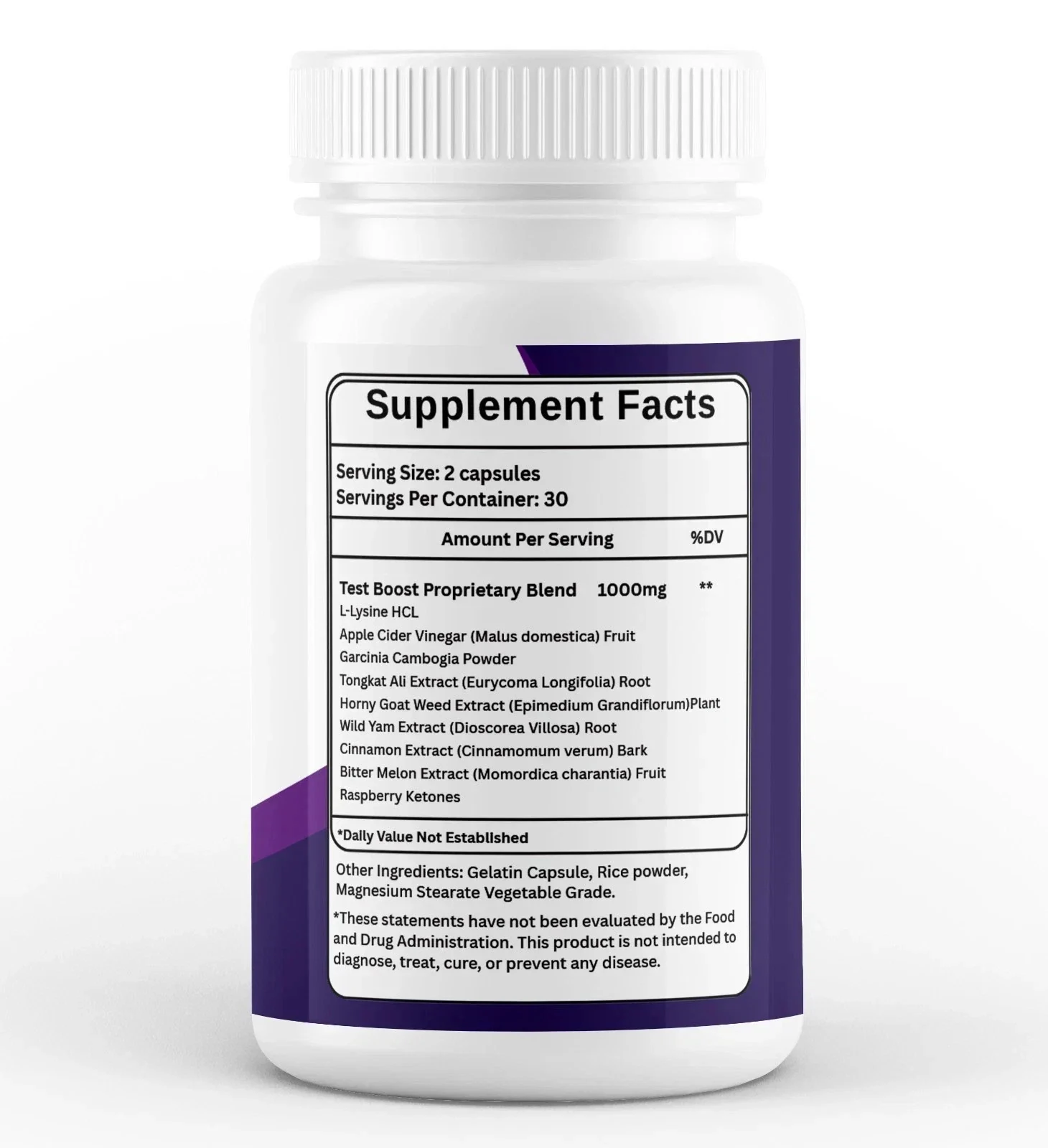
| What the row says | As the bottle prints it |
|---|---|
| Serving size | 2 capsules |
| Servings per container | 30 |
| The single amount line | Test Boost Proprietary Blend 1000mg |
| Ingredients under it | 9, each named, six with a plant part |
| %DV column | One mark, against the blend line |
| Footnote | Daily Value Not Established |
| Other ingredients | Gelatin Capsule, Rice powder, Magnesium Stearate Vegetable Grade |
Read off the printed artwork rather than off any listing graphic. The panel is reproduced row by row on the supplement facts page.
What are the nine ingredients in Nervelin?
Nine rows, read as chemistry rather than as a list of names.
Each card names the active fraction the research follows, the part or form this bottle uses, and where that ingredient’s human evidence sits. The cards are in the order the label prints them.
L-Lysine HCL
an essential amino acidrow one · hydrochloride saltThe one entry on this panel that is not a plant. Lysine cannot be made in the body and arrives in ordinary food — meat, fish, beans, dairy — at several grams a day for most adults, which puts any share of a 1,000 mg blend a long way below a normal diet’s own supply. The hydrochloride form is what keeps a hygroscopic amino acid stable in a dry powder.
Where its human trials went is cold sores. Cochrane’s review of prevention covers that literature and did not find lysine prevented recurrence, and an earlier controlled trial reported the same result in its own title. Nothing in the record connects it to sensation in the feet or hands.
Apple Cider Vinegar
Malus domestica, fruitrow two · dried fruit vinegarFermented apple juice, dried onto a carrier so it can go into a capsule. The active part is acetic acid, and the amount of it that survives drying is a manufacturing variable no label in this category prints.
Its trials are about the hour after a meal rather than about anything chronic. Johnston 2005 measured post-meal glucose with vinegar and peanut products, a 2020 crossover repeated the exercise against a rice meal, and a 2026 urology crossover tested it on urinary stone prevention. Three different endpoints, none of them a nerve.
Garcinia Cambogia Powder
fruit rindrow three · the safety rowThe rind of a small South Asian fruit, milled rather than extracted here: the row says powder, which usually means a lower concentration of hydroxycitric acid than a standardised extract would carry. No percentage is printed, so the hydroxycitric content of this particular row cannot be worked out from the label.
It also carries the one genuine safety signal on the panel. A case series from the US drug-induced liver injury network describes moderate to severe injury with Garcinia alone and combined with green tea. On efficacy, the 1998 JAMA trial used 1,500 mg of hydroxycitric acid a day and separated from placebo on nothing, while a 2014 trial used 2,400 mg a day of extract for lipids. The safety and efficacy review gathers both sides.
Tongkat Ali Extract
Eurycoma longifolia, rootrow four · the best-studied rowRoot of a Malaysian shrub, sold as a water-soluble extract in the trials and as an unspecified extract here. Quassinoids and eurycomanone are the fraction the research follows, and standardised preparations name a percentage. This row names none, so the extract ratio is the maker’s.
The dose is unusually well pinned for a botanical. Tambi 2012 and a six-month randomised trial in older men both used 200 mg a day, which gives a reader an actual figure to hold this row against — if the row had a figure of its own.
Horny Goat Weed Extract
Epimedium grandiflorum, plantrow five · prenylflavonoidsThe whole plant rather than a single part, and the active fraction is a family of prenylated flavonoids with icariin at the head of it. Strength here depends entirely on the icariin percentage, which a standardised trial extract states and this panel does not.
One controlled human trial exists for the fraction. Yong 2021 gave post-menopausal women 740 mg a day of a standardised prenylflavonoid extract for six weeks and measured bone markers. A 2026 overview sets out the chemistry and how much of the rest of the literature is preclinical.
Wild Yam Extract
Dioscorea villosa, rootrow six · diosgeninRoot carrying diosgenin, a plant steroid that a laboratory can convert into human hormones and a human body cannot. That single piece of chemistry is the origin of most of what is written about wild yam, and it has been carried a long way past what it supports.
The one randomised controlled trial in the whole literature gave a wild yam extract to healthy menopausal women and measured symptoms, lipids and sex hormones. It moved none of them. One trial, one flat result, and no second trial in the twenty-five years since.
Cinnamon Extract
Cinnamomum verum, barkrow seven · species namedThe best piece of botanical disclosure on this panel, and it is worth saying so plainly. Cinnamomum verum is true cinnamon rather than cassia, and coumarin is the reason the distinction earns its ink: cassia carries far more of it, and coumarin has a tolerable daily intake of its own.
The glycaemic work is where this ingredient’s evidence sits. A 2024 dose-response meta-analysis pooled the type 2 diabetes trials. Species substitution is common enough that an analytical method exists to detect it, and a low-coumarin alternative species has been proposed for the same reason.
Bitter Melon Extract
Momordica charantia, fruitrow eight · charantin and momordicinA ridged gourd eaten as a vegetable across South and South-East Asia, so the food exposure behind it is large and old. Charantin, momordicin and an insulin-like peptide are the compounds usually named, and the extract ratio decides how much of any of them a capsule carries.
A twelve-week randomised trial in adults with prediabetes ran two arms, 300 mg and 600 mg a day, and a 2020 meta-analysis pooled the hypoglycaemic work in type 2 diabetes. Those are the two records worth reading; the rest of what circulates about this plant is preclinical.
Raspberry Ketones
4-(p-hydroxyphenyl)-2-butanonerow nine · an aroma moleculeThe compound that gives raspberries their smell, produced industrially for flavour and fragrance because extracting it from fruit would cost a fortune. It is a single defined molecule rather than a plant extract, which at least means nobody has to argue about a standardisation percentage.
What it has never had is a human efficacy trial. A 2017 mouse study found it reduced adiposity no further than the drop in food intake explained. The fragrance industry’s safety assessment treats it as what it is, an aroma chemical, and a 2022 dermatology screen lists it among phenols capable of depigmenting skin in cell work.
Which plant parts and forms does Nervelin use?
Nine rows, and how each one’s preparation compares with the preparation its evidence was built on.
| Row | Part or form on this label | Part or form used in the research |
|---|---|---|
| Tongkat Ali | Root extract, ratio unstated | Root, as a standardised water-soluble extract |
| Horny goat weed | Whole plant extract, icariin unstated | A standardised prenylflavonoid extract |
| Garcinia cambogia | Fruit rind powder | Extract standardised to hydroxycitric acid |
| Cinnamon | Cinnamomum verum bark | Mixed across the trials, which is why the meta-analysis had to model a curve |
| Bitter melon | Fruit extract, ratio unstated | Fruit, as a defined extract |
| Wild yam | Root extract | Root extract, in the single trial there is |
| Apple cider vinegar | Dried fruit vinegar | Liquid vinegar, with a meal |
| L-Lysine | Hydrochloride salt | Free base and hydrochloride, both used |
| Raspberry ketones | The isolated molecule | No human trial to compare with |
Six of the nine name a part or a form, which is more disclosure than this price bracket usually offers. What none of them names is a percentage, and a percentage is what turns a plant part into a quantity.
Honest dosage analysis: what one figure on Nervelin can cover
What the format fixes, what it leaves open, and the one sum that follows.
A proprietary blend is a legal disclosure format. It names every ingredient and prints one combined weight, and it is allowed precisely because the recipe is treated as commercial information. The consequence for a reader is arithmetic rather than mystery.
| What the panel fixes | What it leaves open |
|---|---|
| The total, at 1,000 mg for two capsules | How that total divides between nine ingredients |
| The list, all nine named | Which of the nine carries most of the weight |
| The order, which convention puts heaviest first | By how much the first outweighs the ninth |
| The serving, at two capsules | Whether any single row reaches a studied amount |
The left column is a real disclosure and worth crediting. The right column is why the comparison further down has to be done against the total.
Split evenly, nine ways, that total comes to about 111 mg an ingredient. A blend has no obligation to be even and almost certainly is not, so the even split is a reference point rather than an estimate. Set it beside the amounts the trials used and the shape of the panel becomes clear: Tongkat Ali ran at 200 mg a day, horny goat weed at 740 mg, Garcinia at 1,500 mg of hydroxycitric acid, bitter melon at 300 mg in the lower of its two arms. Four rows, 2,740 mg, inside a 1,000 mg total that five more ingredients also share.
That is subtraction rather than an accusation, and both figures come off documents anyone can open. The panel’s total is on the bottle; the trial doses are in the abstracts linked above. What follows from it is stated on how it works and in the panel page, and it is not repeated in every section here.
Because all nine are named, each row can still be checked for what its own literature measured, which is what the cards above do. That is a real answer to a real question, and a label that printed only “proprietary blend” with no list would not support it.
Which nerve compounds are missing from the Nervelin panel?
Three names, three doses, and the reason they are printed here rather than left out.
Three compounds carry randomised trials in peripheral nerve symptoms. All three have a dose the trials report plainly. None of the three is on this list, and naming them is more useful to a reader than another round of arithmetic about the nine that are.
| Compound | Dose its trials used | The record |
|---|---|---|
| Alpha-lipoic acid | 600 mg a day | The critical review of thioctic acid in symptomatic diabetic polyneuropathy |
| Benfotiamine | 300 mg and 600 mg a day | The BENDIP randomised trial, with two later controlled studies over twelve months |
| Acetyl-L-carnitine | 2,000 mg a day orally | A long-term randomised, double-blind, placebo-controlled study in diabetic neuropathy |
Sources: the thioctic acid review, BENDIP and the acetyl-L-carnitine study. Those three are named so their absence is checkable rather than asserted.
A panel of nine botanicals can be a perfectly reasonable daily capsule without any of them. What it cannot be is the thing a reader assumes when the front of the carton prints a nerve icon, and the difference is worth knowing before the basket rather than after a second bottle. The benefits page works through what the three printed lines actually mean.
What else is inside a Nervelin capsule?
Three entries under the panel, one of which decides the purchase for some buyers.
Three lines account for everything that is not in the blend: gelatin capsule, rice powder, magnesium stearate vegetable grade.
Gelatin, the shell
Animal collagen, and the standard material for a two-piece capsule. It is tasteless, it dissolves in the stomach within minutes and it keeps a botanical powder dry on a shelf. It also settles the purchase for anyone on a vegetarian or vegan diet, which is why it is stated here in the same breath as the other two rather than in a footnote.
Rice powder, the filler
Bulk, and an ordinary one. A two-piece capsule has a fixed internal volume and a blend of extracts rarely fills it, so an inert powder makes up the difference and keeps the fill weight repeatable from bottle to bottle.
Magnesium stearate, vegetable grade
A flow agent. It stops powder sticking to the machinery that meters it, which is what makes 1,000 mg mean 1,000 mg on the hundred-thousandth capsule as well as the first. The grade is named, which is the detail a reader avoiding animal-derived stearates would want.
Nervelin ingredient questions
How many ingredients are in Nervelin?
Nine, all named on the panel, inside one heading: Test Boost Proprietary Blend at 1,000 mg for a two-capsule serving. Three more lines sit underneath as inactive ingredients: gelatin capsule, rice powder, magnesium stearate vegetable grade.
Is there a proprietary blend?
Yes. One figure, 1,000 mg, covers all nine. The blend is named and its contents are listed in full, which is the part a reader can use; what no row carries is a milligram of its own.
Which ingredient is present in the largest amount?
The panel does not say. Convention puts the heaviest ingredient first, which would make L-lysine the largest row and raspberry ketones the smallest, but convention is not a declaration and the gap between first and ninth could be anything.
Is the Tongkat Ali standardised?
The row names the root and the species and stops there. Trial-grade Tongkat Ali is usually a water-soluble extract with a stated quassinoid content, and this panel prints neither the ratio nor a marker percentage.
Is the cinnamon cassia?
No. The panel names Cinnamomum verum, which is true cinnamon and the lower-coumarin species. That is a real piece of disclosure and one of the better decisions on this label.
Is Nervelin vegetarian?
No. The capsule shell is gelatin, which is animal collagen. The other two inactive lines, rice powder and vegetable-grade magnesium stearate, are both plant-derived, but the shell settles it.
Does it contain caffeine or a stimulant?
Nothing on the panel is a stimulant. Raspberry ketone is an aroma molecule rather than a thermogenic in any human sense, and none of the eight botanicals has a stimulant action at any dose a capsule could hold.
Sources for the Nervelin ingredient list
Grouped by the row they belong to, in the order the panel prints the ingredients.
- Chi CC, Wang SH, Delamere FM, et al. Interventions for prevention of herpes simplex labialis (cold sores on the lips). Cochrane Database Syst Rev. 2015;2015(8):CD010095. PMID 26252373. https://pubmed.ncbi.nlm.nih.gov/26252373/
- Simon CA, Van Melle GD, Ramelet AA. Failure of lysine in frequently recurrent herpes simplex infection. Arch Dermatol. 1985;121(2):167-8. PMID 3919651. https://pubmed.ncbi.nlm.nih.gov/3919651/
- Johnston CS, Buller AJ. Vinegar and peanut products as complementary foods to reduce postprandial glycemia. J Am Diet Assoc. 2005;105(12):1939-42. PMID 16321601. https://pubmed.ncbi.nlm.nih.gov/16321601/
- Zhao W, Wang L, Fan Z, et al. Co-ingested vinegar-soaked or preloaded dried apple mitigated acute postprandial glycemia of rice meal in healthy subjects under equicarbohydrate conditions. Nutr Res. 2020;83:108-118. PMID 33075621. https://pubmed.ncbi.nlm.nih.gov/33075621/
- Baker B, Herforth C, Low J, et al. Apple cider vinegar for prevention of urinary lithiasis (APUL): a randomized crossover trial. Int Urol Nephrol. 2026;58(6):1989-1994. PMID 41351751. https://pubmed.ncbi.nlm.nih.gov/41351751/
- Heymsfield SB, Allison DB, Vasselli JR, et al. Garcinia cambogia (hydroxycitric acid) as a potential antiobesity agent: a randomized controlled trial. JAMA. 1998;280(18):1596-600. PMID 9820262. Dose used: 1,500 mg hydroxycitric acid per day. No effect beyond placebo. https://pubmed.ncbi.nlm.nih.gov/9820262/
- Vasques CA, Schneider R, Klein-Junior LC, et al. Hypolipemic effect of Garcinia cambogia in obese women. Phytother Res. 2014;28(6):887-91. PMID 24133059. Dose used: 2.4 g/day of extract (800 mg three times daily) for 60 days. https://pubmed.ncbi.nlm.nih.gov/24133059/
- Marquez F, Babio N, Bullo M, et al. Evaluation of the safety and efficacy of hydroxycitric acid or Garcinia cambogia extracts in humans. Crit Rev Food Sci Nutr. 2012;52(7):585-94. PMID 22530711. https://pubmed.ncbi.nlm.nih.gov/22530711/
- Vuppalanchi R, Bonkovsky HL, Ahmad J, et al. Garcinia cambogia, Either Alone or in Combination With Green Tea, Causes Moderate to Severe Liver Injury. Clin Gastroenterol Hepatol. 2022;20(6):e1416-e1425. PMID 34400337. https://pubmed.ncbi.nlm.nih.gov/34400337/
- Tambi MI, Imran MK, Henkel RR. Standardised water-soluble extract of Eurycoma longifolia, Tongkat ali, as testosterone booster for managing men with late-onset hypogonadism? Andrologia. 2012;44 Suppl 1:226-30. PMID 21671978. Dose used: 200 mg/day. https://pubmed.ncbi.nlm.nih.gov/21671978/
- Leitao AE, Vieira MCS, Pelegrini A, et al. A 6-month, double-blind, placebo-controlled, randomized trial to evaluate the effect of Eurycoma longifolia (Tongkat Ali) and concurrent training on erectile function and testosterone levels in androgen deficiency of aging males (ADAM). Maturitas. 2021;145:78-85. PMID 33541567. Dose used: 200 mg/day for 6 months. https://pubmed.ncbi.nlm.nih.gov/33541567/
- Yong EL, Cheong WF, Huang Z, et al. Randomized, double-blind, placebo-controlled trial to examine the safety, pharmacokinetics and effects of Epimedium prenylflavonoids, on bone specific alkaline phosphatase and the osteoclast adaptor protein TRAF6 in post-menopausal women. Phytomedicine. 2021;91:153680. PMID 34352588. Dose used: 740 mg/day of extract for 6 weeks. https://pubmed.ncbi.nlm.nih.gov/34352588/
- Fris AS, Lazarova I, Georgieva M, et al. An Overview of the Phytochemistry, Biological Activities and Therapeutic Potential of Epimedium spp. Plants (Basel). 2026;15. PMID 42514482. https://pubmed.ncbi.nlm.nih.gov/42514482/
- Komesaroff PA, Black CV, Cable V, et al. Effects of wild yam extract on menopausal symptoms, lipids and sex hormones in healthy menopausal women. Climacteric. 2001;4(2):144-50. PMID 11428178. No effect on any measured outcome. https://pubmed.ncbi.nlm.nih.gov/11428178/
- Moridpour AH, Kavyani Z, Khosravi S, et al. The effect of cinnamon supplementation on glycemic control in patients with type 2 diabetes mellitus: An updated systematic review and dose-response meta-analysis of randomized controlled trials. Phytother Res. 2024;38(1):117-130. PMID 37818728. https://pubmed.ncbi.nlm.nih.gov/37818728/
- Abraham K, Wohrlin F, Lindtner O, et al. Toxicology and risk assessment of coumarin: focus on human data. Mol Nutr Food Res. 2010;54(2):228-39. PMID 20024932. https://pubmed.ncbi.nlm.nih.gov/20024932/
- Pages-Rebull J, Sagrista G, Perez-Rafols C, et al. Application of HPLC-UV combined with chemometrics for the detection and quantification of 'true cinnamon' adulteration. Talanta. 2024;271:125676. PMID 38266436. https://pubmed.ncbi.nlm.nih.gov/38266436/
- Yeh TF, Lin CY, Chang ST. A potential low-coumarin cinnamon substitute: Cinnamomum osmophloeum leaves. J Agric Food Chem. 2014;62(7):1706-12. PMID 24475880. https://pubmed.ncbi.nlm.nih.gov/24475880/
- Guarneiri LL, Wilcox ML, Kuan CM, et al. Investigation of the Influence of a Bitter Melon Product on Indicators of Cardiometabolic Health in Adults with Prediabetes. J Am Nutr Assoc. 2025;44(4):306-314. PMID 39536276. Doses used: 300 mg/day and 600 mg/day for 12 weeks. https://pubmed.ncbi.nlm.nih.gov/39536276/
- Kim SK, Jung J, Jung JH, et al. Hypoglycemic efficacy and safety of Momordica charantia (bitter melon) in patients with type 2 diabetes mellitus. Complement Ther Med. 2020;52:102524. PMID 32951763. https://pubmed.ncbi.nlm.nih.gov/32951763/
- Cotten BM, Diamond SA, Banh T, et al. Raspberry ketone fails to reduce adiposity beyond decreasing food intake in C57BL/6 mice fed a high-fat diet. Food Funct. 2017;8(4):1512-1518. PMID 28378858. Animal study. https://pubmed.ncbi.nlm.nih.gov/28378858/
- Api AM, Belsito D, Biserta S, et al. RIFM fragrance ingredient safety assessment, 4-(p-hydroxyphenyl)-2-butanone, CAS Registry Number 5471-51-2. Food Chem Toxicol. 2019;134 Suppl 2:110948. PMID 31756354. That CAS number is raspberry ketone. https://pubmed.ncbi.nlm.nih.gov/31756354/
- Nishimaki-Mogami T, Ito S, Cui H, et al. A cell-based evaluation of human tyrosinase-mediated metabolic activation of leukoderma-inducing phenolic compounds. J Dermatol Sci. 2022;108(2):77-86. PMID 36567223. https://pubmed.ncbi.nlm.nih.gov/36567223/
- Ziegler D. Thioctic acid for patients with symptomatic diabetic polyneuropathy: a critical review. Treat Endocrinol. 2004;3(3):173-89. PMID 16026113. Dose used: 600 mg/day. https://pubmed.ncbi.nlm.nih.gov/16026113/
- Stracke H, Gaus W, Achenbach U, et al. Benfotiamine in diabetic polyneuropathy (BENDIP): results of a randomised, double blind, placebo-controlled clinical study. Exp Clin Endocrinol Diabetes. 2008;116(10):600-5. PMID 18473286. Doses used: 300 mg/day and 600 mg/day. https://pubmed.ncbi.nlm.nih.gov/18473286/
- De Grandis D, Minardi C. Acetyl-L-carnitine (levacecarnine) in the treatment of diabetic neuropathy. A long-term, randomised, double-blind, placebo-controlled study. Drugs R D. 2002;3(4):223-31. PMID 12455197. Dose used: 1,000 mg/day intramuscular for 10 days, then 2,000 mg/day orally for the remaining 355 days. https://pubmed.ncbi.nlm.nih.gov/12455197/
Order Nervelin with all nine names in front of you
Two capsules a day, 60 to a bottle, nine botanicals under one 1,000 mg figure, and every row set beside the amount its own published trials used.
Price shown at the seller’s checkout · money-back guarantee on the listing window
Order Nervelin On The Official WebsiteTwo capsules a day · 60 per bottle · lot NER-26/GO-5362