Nervelin Official Website › Blog › When A Label Disagrees With Itself
When The Front And The Back Of A Label Disagree
The front of this carton prints three support lines and a nerve icon. The back prints a blend whose own name refers to testosterone, over nine ingredients that are at home in three other aisles. Both faces are accurate. Only one of them is the formula, and it is worth knowing which.
- A carton has two jobs and they are done by two different faces.
- The front is positioning: what the product is being sold for, in the language a supplement is allowed to use.
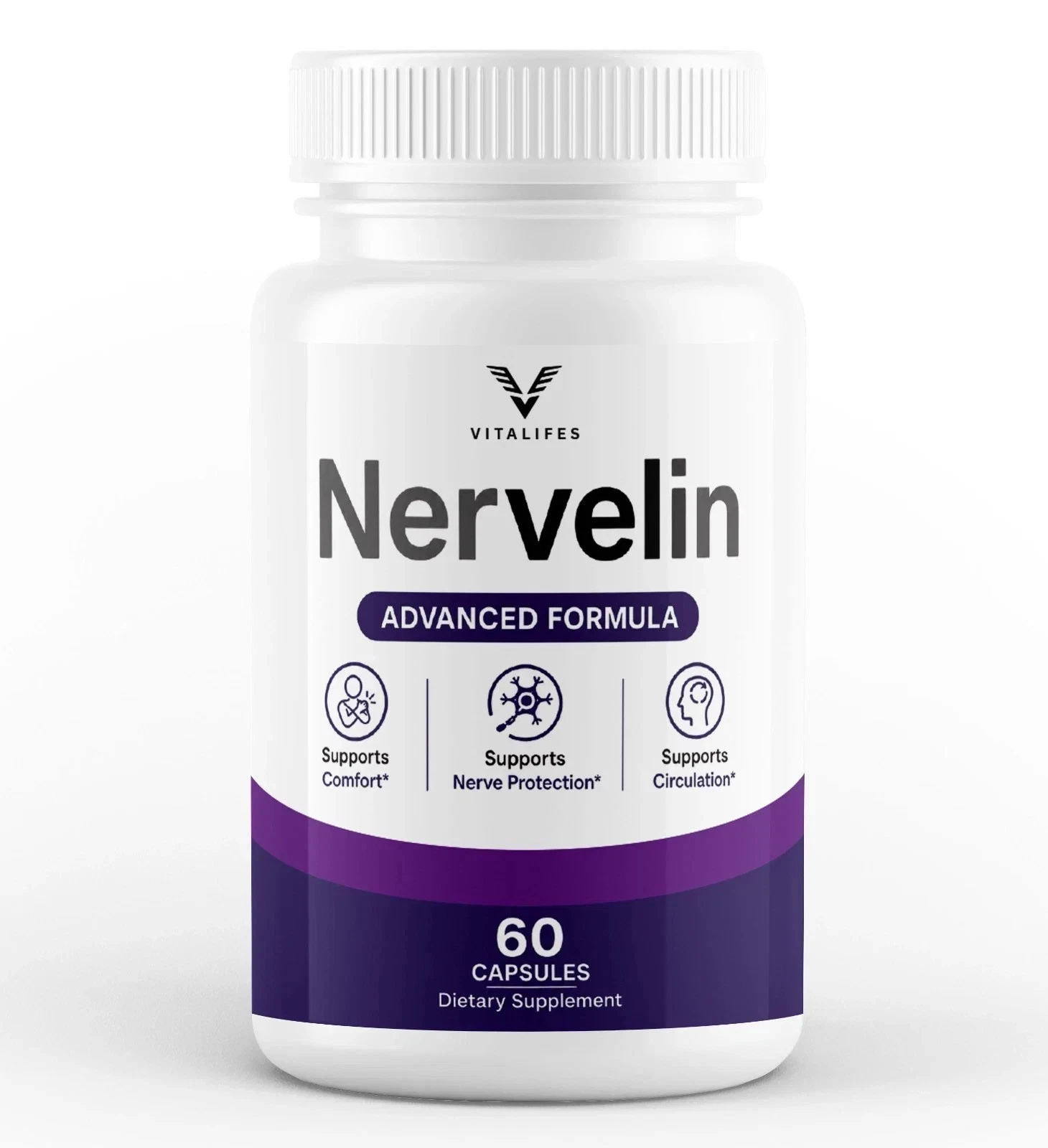
- The back is the declaration: Test Boost Proprietary Blend at 1,000 mg over 9 names.
- The blend's own printed name refers to testosterone, not to nerves.
- Where the two faces point in different directions, the back is the one that describes what is in the capsule.
A carton has two jobs
Every supplement box in every shop does two separate things, and they are governed by different rules.
The front does the selling. It carries the product name, a short description of what it is for, and whatever graphic makes the category obvious at arm's length. The language it may use is constrained: a supplement may make structure-and-function claims and may not make disease claims, which is why every carton in every aisle says supports rather than treats.
The back does the declaring. The Supplement Facts panel is a required disclosure with a required format, and it is the only part of a carton a reader can check against anything. It is also, on most products, the part nobody reads.
Why the front cannot settle anything
Because support language is a legal category rather than a measurement. Three products with identical support lines have not made identical claims; they have made no claims at all, in the only words available. The federal overview sets out why the wording looks the way it does.
What each face of this carton says
| The front of the carton | The back of the carton | |
|---|---|---|
| What it names | Three support lines and a nerve icon | Nine ingredients and one weight |
| What it is for, by implication | Comfort, nerve protection, circulation | A blend whose own name refers to testosterone |
| What can be checked | Nothing; no ingredient appears | The names, their order, the serving and the count |
| Regulatory status of the wording | Permitted structure-and-function language | A required Supplement Facts declaration |
| Which one is the formula | No | Yes |
Two faces of one carton, and only one of them is the product.
The front prints “supports comfort”, “supports nerve protection”, “supports circulation” and a nerve icon. Nothing on that face names an ingredient, a weight or a form.
The back prints Test Boost Proprietary Blend at 1,000 mg, and underneath it: L-Lysine HCL, Apple Cider Vinegar, Garcinia Cambogia Powder, Tongkat Ali Extract, Horny Goat Weed Extract, Wild Yam Extract, Cinnamon Extract, Bitter Melon Extract, Raspberry Ketones. The blend's own printed name is the detail most readers walk past, and it is the loudest thing on the panel once it has been noticed.
Where these nine ingredients usually live
The quickest way to see the gap is to ask, for each name, which aisle it is normally found in.
| Ingredient on this panel | The market it usually appears in |
|---|---|
| Tongkat Ali | Testosterone and male vitality |
| Horny goat weed | Male vitality; bone and lipid research in women |
| Garcinia cambogia | Appetite and body-composition products |
| Raspberry ketones | Body-composition products |
| Apple cider vinegar | Glucose and general-wellness products |
| Bitter melon | Glucose products |
| Cinnamon | Glucose products |
| Wild yam | Menopause products |
| L-lysine | Cold-sore products |
Nine ingredients, and not one of the nine is native to the nerve aisle.
Three glucose ingredients, two male-vitality ingredients, two body-composition ingredients, one menopause ingredient and one cold-sore ingredient. Nine names, four markets, and none of the four is the nerve aisle.
The glucose cluster is the one worth pausing on, because it is the only coherent story anybody could tell here. Diabetes is the commonest cause of peripheral neuropathy in the United States, so an ingredient with a glucose literature has at least an indirect connection to the symptom. That is a hypothesis about a mechanism, not a finding, and the distance between those two words is the whole of the argument.
Read the Nervelin panel for yourself
The back of the carton is reproduced at reading size, every row is set beside what its own research used, and the blend line is printed exactly as the label has it.
Price shown at the seller’s checkout · money-back guarantee on the listing window
Order Nervelin On The Official WebsiteTwo capsules a day · 60 per bottle · lot NER-26/GO-5362
Neither face is wrong, which is the confusing part
It would be simpler if one side were false. Neither is.
The front is printed in language a supplement is permitted to use, and it does not claim a trial result, a treatment or an outcome. The back is a correct declaration in the required format, with the required descending order and the required footnote.
What is happening is not a misstatement. It is two different registers doing two different jobs on one box, and a reader who only ever sees the front will finish with an impression the back does not support. A framework for ingredient-interpretation gaps describes exactly this distance between what is printed, what is understood and what is present.
Why a formula gets printed two ways
Three explanations cover most cases and all three are ordinary commercial behaviour rather than anything exotic.
The first is that one blend gets sold into several markets. A manufacturer with a working formula and a filled capsule has every reason to print several cartons around it, and the panel stays the same while the front changes.
The second is that the markets genuinely overlap. Men over fifty with metabolic problems buy testosterone products, glucose products and nerve-comfort products, often in the same month. A formula aimed at one of those buyers reaches the other two without any change.
The third is simply that the front is where the competition happens. A nerve icon sells to somebody with burning feet in a way that a blend name never will, and the blend name is on the side nobody photographs.
There is a fourth possibility that deserves stating because it is the least cynical of the four. A maker may genuinely believe the formula suits both markets. Three of these nine ingredients have glucose literatures, diabetes is the commonest cause of peripheral neuropathy in the United States, and somebody joining those two facts is reasoning rather than inventing. The reasoning is still a hypothesis, and a hypothesis printed as an icon on the front of a box looks like a finding.
What to do when the faces disagree
- Believe the back. It is the declaration, it is checkable, and it is what the maker is accountable for.
- Read the blend name as well as the ingredient list. On this carton the blend's own name is the most informative two words on the panel.
- Ask which market each ingredient is native to. Four markets and nine names is a signal worth noticing.
- Look for any ingredient with a trial for the symptom on the front. If there is none, the front is a positioning decision rather than a summary of the evidence.
- Check the other-ingredients line for anything that rules the product out for you, which on this carton is the gelatin shell.
- Decide on the back. A buyer who is content with the back will not be disappointed by the front.
The ceiling this puts on what anyone can say
This desk sells the product and still has to write inside the same limit, so it is worth stating the limit out loud.
The three lines on the front are what the label claims, and they are reported here as what the label claims rather than asserted as findings. No ingredient on this panel has a human peripheral-nerve trial behind it, so there is nothing to assert. The seller also ships two marketing panels with the product art whose headlines reach further than the carton does, and their wording appears nowhere in this website's prose.
That is the whole of the discipline: report the carton, print the panel, set each row beside its own research, and let a reader decide. The federal guidance on using supplements wisely is the short version of the same idea from the buyer's side.
Six habits of somebody who reads the back first
- Turns the box over before reading the front, every time, in every aisle.
- Reads the blend name, not only the ingredient list underneath it.
- Counts the names and divides the total, to get a ceiling rather than an estimate.
- Knows the published dose for two or three ingredients by heart, which is enough to calibrate almost any panel.
- Treats the seal wall as a set of statements about a factory rather than about a capsule.
- Buys on the panel and lets the front be what it is.
When the two faces of a carton describe different products, the panel is the product and the front is the advertisement.
References
- Tambi MI, Imran MK, Henkel RR. Standardised water-soluble extract of Eurycoma longifolia, Tongkat ali, as testosterone booster for managing men with late-onset hypogonadism? Andrologia. 2012;44 Suppl 1:226-30. PMID 21671978. Dose used: 200 mg/day. https://pubmed.ncbi.nlm.nih.gov/21671978/
- Yong EL, Cheong WF, Huang Z, et al. Randomized, double-blind, placebo-controlled trial to examine the safety, pharmacokinetics and effects of Epimedium prenylflavonoids, on bone specific alkaline phosphatase and the osteoclast adaptor protein TRAF6 in post-menopausal women. Phytomedicine. 2021;91:153680. PMID 34352588. Dose used: 740 mg/day of extract for 6 weeks. https://pubmed.ncbi.nlm.nih.gov/34352588/
- Heymsfield SB, Allison DB, Vasselli JR, et al. Garcinia cambogia (hydroxycitric acid) as a potential antiobesity agent: a randomized controlled trial. JAMA. 1998;280(18):1596-600. PMID 9820262. Dose used: 1,500 mg hydroxycitric acid per day. No effect beyond placebo. https://pubmed.ncbi.nlm.nih.gov/9820262/
- Alsawadi A. The Perception Filler: A Proposed Conceptual Framework for Ingredient-Interpretation Gaps in Food Supplements. J Nutr. 2026;156(10):101803. PMID 42660500. https://pubmed.ncbi.nlm.nih.gov/42660500/
- National Center for Complementary and Integrative Health. Dietary and Herbal Supplements. Confirmed live 19 September 2026. https://www.nccih.nih.gov/health/dietary-and-herbal-supplements
- National Center for Complementary and Integrative Health. Using Dietary Supplements Wisely. Confirmed live 19 September 2026. https://www.nccih.nih.gov/health/using-dietary-supplements-wisely